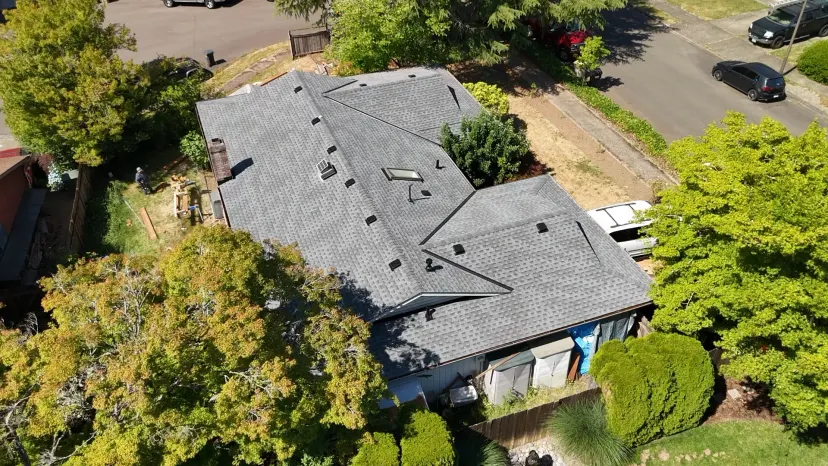
The lifespan charts you'll find on national websites don't apply here. A shingle rated for thirty years in Arizona lives a different life under forty-plus inches of Oregon rain, nine months of damp, and a canopy of Douglas firs. After years of tearing off roofs across the Portland metro, here's what we actually see each material deliver — and what separates the roofs that reach the top of the range from the ones that don't.
How long each material really lasts in the PNW
Composition asphalt shingles are what most Portland-area homes wear, and they come in two grades. Basic 3-tab shingles give you 15 to 20 years here. Architectural shingles — the GAF Timberline line we install — run 20 to 30 years with moss maintenance, and the added thickness holds up noticeably better in wind. Cedar shake is the wild card: we've torn off cedar at 18 years that was never maintained, and inspected cedar at 35 that was cleaned, treated, and well ventilated its whole life. Low-slope sections with membrane roofing land at 15 to 25 years depending on how well seams and penetrations were detailed.
| Roofing material | Realistic PNW lifespan | Maintenance level |
|---|---|---|
| 3-tab asphalt shingles | 15–20 years | Low — until the end, which arrives fast |
| Architectural composition shingles (GAF Timberline) | 20–30 years | Moderate — moss treatment and debris clearing |
| Cedar shake | 20–40 years | High — cleaning, treatment, and ventilation decide the range |
| Low-slope membrane (TPO, torch-down) | 15–25 years | Moderate — check seams, penetrations, and ponding |
What shortens a roof's life in Oregon
Moss is the obvious one. It roots into the shingle surface, lifts the edges so wind-driven rain gets underneath, and holds moisture against the mat for months at a stretch. Shade and tree canopy make everything worse: a roof that never fully dries is a roof aging in fast-forward, and fir needles mat together in valleys where they act like a sponge against the shingles. Deferred gutter maintenance belongs on this list too — overflowing gutters soak the eaves and fascia and can push water back under the first course of shingles, which is why we treat gutters as part of the roof system, not an accessory.
The quieter killer is poor attic ventilation. An under-vented attic traps moisture all winter — we've opened attics with mold blooming on the sheathing under a ten-year-old roof — and bakes the shingles from below in summer. Every roof we install includes balanced intake and exhaust ventilation for exactly this reason. Finally, small failures left alone become big ones: a cracked pipe boot costs little to fix today and a section of rotted decking to fix in three years.
Wind deserves a mention too. A single Gorge wind event might only cost you a shingle or two, but each one weakens the seal strips around it, and the cumulative effect on an older roof adds up. After any storm that takes shingles off, have the roof looked at — the repair is minor now and structural later. Cedar roofs face their own Oregon-specific problem: constant damp invites rot and moss between the shakes, which is why unmaintained cedar fails at the bottom of its range while cleaned, treated, and well-ventilated cedar reaches forty years.
What extends it
- Treat moss annually with a soft-wash treatment — never a pressure washer, which strips protective granules and does more harm than the moss.
- Clean gutters every fall at minimum, or fit gutter covers, so water goes where it's supposed to through the rainy season.
- Trim branches back from the roofline so the surface can dry and needles have farther to fall.
- Keep attic ventilation balanced: clear soffit intakes, unobstructed ridge or roof vents, and insulation that isn't blocking airflow at the eaves.
- Fix small failures immediately — pipe boots, lifted flashing, a missing shingle after a wind event.
- Get a professional inspection every two to three years, and after any major wind storm, while small problems are still small.
When aging becomes replacement territory
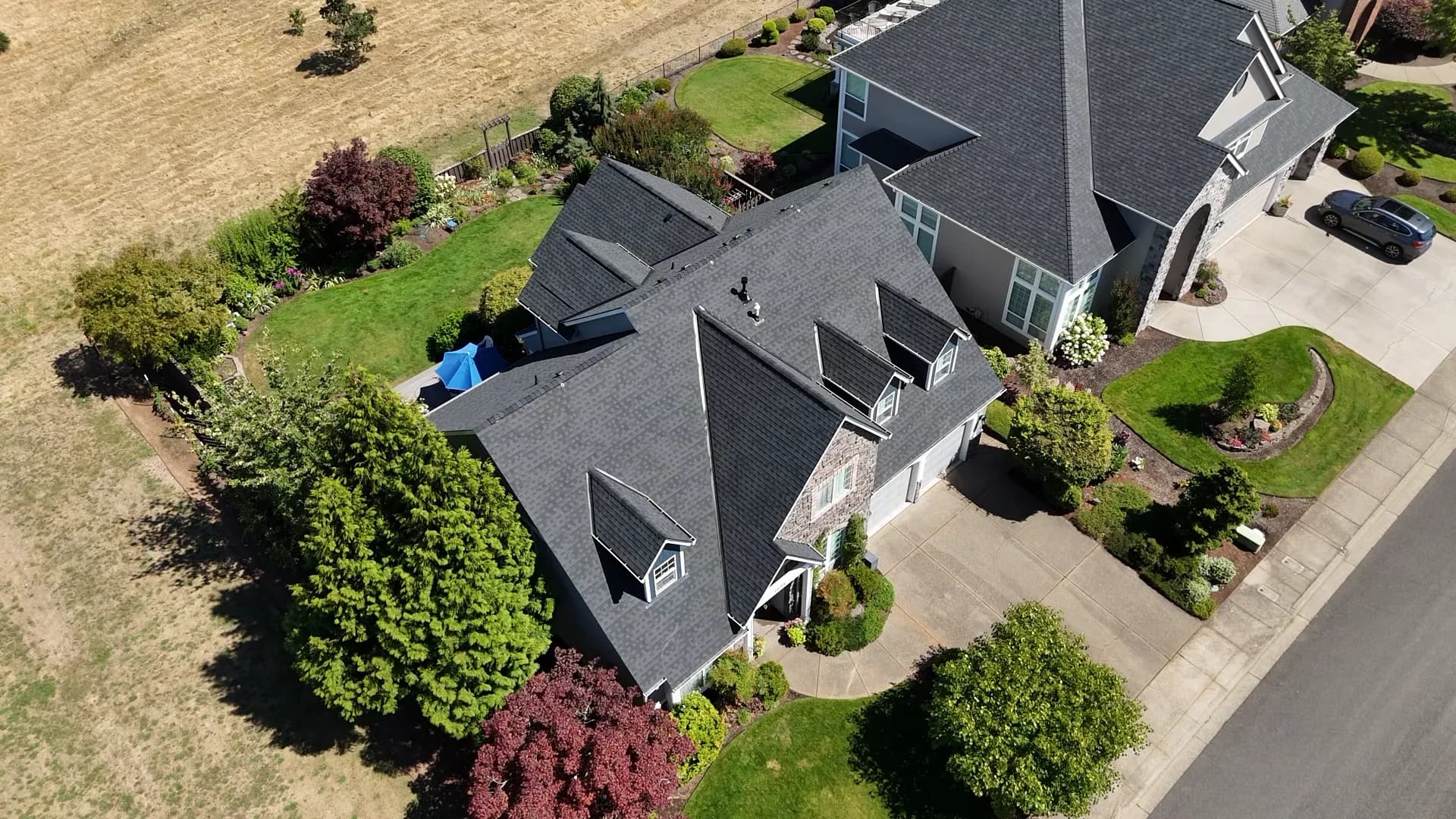
Some signs are visible from the ground. Widespread granule loss — bare patches on the shingles and gutters full of grit — means the surface protection is gone and the asphalt is exposed to UV. Curling or cupping shingle edges, shingles cracking or blowing off after every wind event, and chronic leaks in more than one spot all tell the same story. From inside the attic, daylight through the roof boards, stained or sagging sheathing, and musty insulation are end-of-life findings, not repair items.
The rule of thumb we give homeowners: once a roof is past its design life and repairs are piling up, stop repairing and start planning. A planned replacement happens on your schedule, in dry weather, with time to compare materials. An emergency replacement happens in January, under a tarp, at the worst possible moment. For current budgeting, an architectural shingle roof replacement runs $700 to $1,200 per square installed in the Portland area, and our instant estimate tool will give you a ballpark for your home's size in about a minute. And if you want to see the options before the numbers, preview GAF Timberline HDZ colors on your home with RoofVision.
If you're not sure where your roof stands, that's a ten-minute conversation. We inspect roofs across Portland and the rest of the metro every week — call (971) 525-6764 and we'll tell you plainly whether yours has years left or it's time to plan.
Common questions
How long does a GAF architectural shingle roof last in Oregon?
Realistically 20 to 30 years in our climate, and maintenance decides where you land in that range. A roof that gets annual moss treatment and stays clear of debris trends toward thirty; a shaded, neglected roof can be done at twenty. That's why we build every roof replacement as a full system — underlayment, flashing, and ventilation matter as much as the shingles.
Does moss actually shorten a roof's life?
Yes, and it's the number-one life-shortener we see in the Portland area. Moss roots lift shingle edges so wind-driven rain gets underneath, and the growth itself holds moisture against the shingle mat for months at a time. Left alone for years, it can take a decade off a composition roof.
My roof is 22 years old and not leaking. Should I replace it?
Not automatically — condition beats age. Have it inspected: if the shingles still lie flat, granule loss is modest, and the flashing is sound, you may have years left. But past the design life, you should be budgeting and planning rather than waiting for the first January leak to decide your timeline.
Is it okay to pressure wash moss off a roof?
No. Pressure washing strips the protective granules off composition shingles and does more damage in an afternoon than the moss did in years. The right approach is a soft treatment that kills the growth, then letting it release over the following weeks, with gentle removal of what's left.
How do I know whether to repair or replace?
Two questions decide it: how old is the roof, and how widespread is the problem. A single leak on a ten-year-old roof is a repair. A leak on a roof at the end of its design life, or damage spread across multiple slopes, usually means replacement — money spent repairing a roof you'll replace in two years is money wasted.