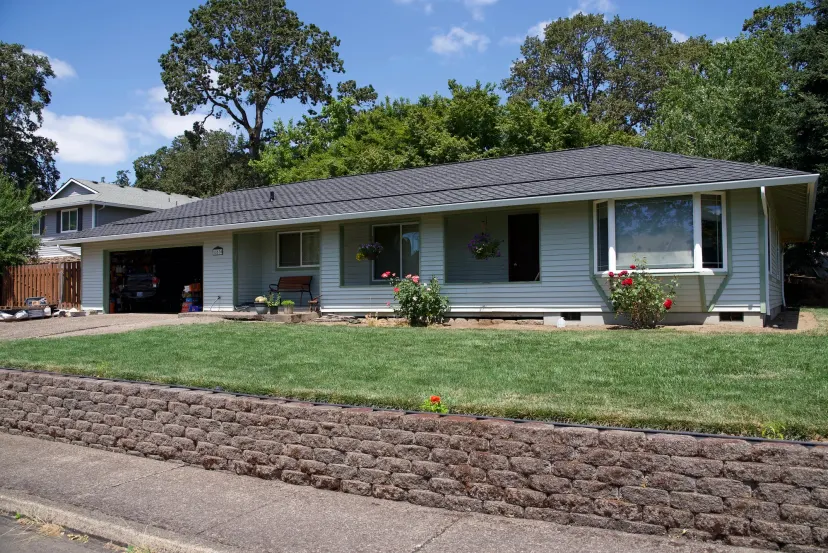
James Hardie fiber cement has become the default answer for Portland siding replacements, and it's not hard to see why: it survives our nine-month wet season, it doesn't rot or feed pests, and it looks like painted wood because it's molded from it. But what does it actually cost? I'm an estimator, and I build siding proposals across the metro every week. This guide gives you the real 2026 numbers we work from, explains the math behind them, and walks through the choices that move your price up or down. As a James Hardie ALLIANCE member, we install these products the way the manufacturer trains and warrants them — which matters more to your cost over thirty years than any line item on the bid.
Typical Hardie siding cost in Portland (2026)
Our installed range for James Hardie siding is $15 to $25 per square foot of wall area, and that number includes the full job: tearing off and disposing of your existing siding, inspecting and repairing the sheathing where needed, a weather-resistive barrier and flashing at every opening, the Hardie products themselves installed to spec, trim and corners, and daily cleanup. It's the whole wall assembly, not just planks on a nail.
| Wall area | Typical installed range | Common home size this fits |
|---|---|---|
| 1,000 sq ft (10 squares) | $16,700 – $24,850 | Smaller ranch or bungalow |
| 1,500 sq ft (15 squares) | $22,410 – $37,350 | Typical split-level or mid-size two-story |
| 2,000 sq ft (20 squares) | $30,125 – $46,350 | Larger two-story or complex floor plan |
Treat these as planning ranges, not quotes. A house with simple gable walls and few windows prices toward the low end; a house with bump-outs, gable-end shake accents, and a lot of trim prices toward the top. The only honest number is the one measured on your walls — that's why our siding installation service starts with a free walkthrough and an itemized proposal rather than a ballpark over the phone.
What 'a square' means for siding
Like roofers, siders talk in squares: one square equals 100 square feet of wall. The confusion for homeowners is that wall area has little to do with floor area. A 1,600-square-foot ranch might have 1,200 square feet of siding once you measure every exterior wall and subtract the windows and doors; a 2,400-square-foot two-story can have less wall than you'd guess because so much of the house is stacked. Gable ends add triangles of area people forget to count, and every window and door opening gets subtracted from the area but adds trim labor back around its perimeter.
When we estimate, we measure each wall — we don't multiply your square footage by a rule of thumb. That's how you end up with a proposal that holds. If a contractor quotes you a price per square based only on your home's listed square footage, expect the number to change after the walkthrough.
HardiePlank vs. HardiePanel vs. HardieShingle: price differences
The Hardie product line isn't one product, and the choice affects both cost and character. HardiePlank lap siding is the workhorse — the horizontal lap look on most Portland resided homes, and the most economical to install because the pieces are long, regular, and fast to hang. HardiePanel vertical siding, usually paired with batten strips for a board-and-batten look, runs a bit more: the panels go up quickly but the battens, trim-out, and detailing add labor. HardieShingle — the shake-look siding you see in gable ends and on Craftsman and Cape Cod homes — is the most labor-intensive, because each course is laid, spaced, and detailed by hand.
Most of the homes we side mix products: HardiePlank on the main walls, HardieShingle in the gables, HardiePanel and batten on an accent wall. That's a genuinely good strategy for budget control — put the premium profile where the street sees it and the economical profile everywhere else. All of it sits inside the $15 to $25 per-square-foot installed range; where a given house lands depends on this mix, the trim package, and the condition of what's underneath. You can preview these profiles and colors on a photo of your own home with SidingVision, our siding visualization tool before you commit to anything.
Where the money goes: tear-off, trim, and paint
Tear-off and what's underneath
Every range above includes removing and disposing of your old siding, and in Portland that step earns its keep. Older homes here hide things: original cedar siding under a layer of aluminum or vinyl, sheathing softened by decades of slow leaks around windows, the occasional wall with no weather barrier at all. On pre-1980 homes we routinely find some sheathing repair once the walls are open, which is why proposals price that work per sheet rather than pretending it won't happen. This is also the moment to add exterior insulation or fix flashing details that were wrong from the day the house was built — cheap to do while the wall is naked, expensive to do later.
Trim, corners, and soffit
Trim is where siding budgets quietly grow. Corner boards, window and door casings, frieze boards, fascia, and soffit are all separate material and labor, and a house with lots of openings has lots of trim linear footage. HardieTrim boards match the siding's durability and hold paint the same way; they're standard on our installs. When you compare bids, check whether trim is itemized or buried — a low headline number sometimes means the trim package got thin.
Primed and painted vs. ColorPlus
Hardie siding arrives either primed for field painting or finished with ColorPlus, Hardie's factory-applied baked-on finish. Primed-and-painted costs less up front and gives you any color on earth; ColorPlus costs more per square but comes with a 15-year finish warranty and a factory coating no field painter can match. In our climate, where north-facing walls stay damp for months and south-facing walls take all the UV we get, factory finish holds noticeably longer between repaints. We price both options in proposals so you can weigh the upfront difference against the maintenance cycles.
One more budget note that surprises people: scheduling and season. Siding is year-round work in Portland, but field painting in the wet months has to wait for dry windows, which is one more argument for ColorPlus if you're residing between October and May. And if your home sits in one of Portland's historic districts, design review can add both time and documentation to the project — worth knowing before you set a timeline, and something we flag during the consultation rather than after you've signed.
The 30-year warranty and what it's actually worth
Every James Hardie siding product carries a 30-year, non-prorated substrate warranty — the fiber cement itself is warranted not to rot, warp, or delaminate for three decades. That's on top of the ColorPlus finish warranty and our own written workmanship guarantee. The catch, if you can call it that, is installation: the warranty assumes the product went on per spec, with the right clearances, fastening, and flashing. That's the practical value of hiring an ALLIANCE-trained installer — the wall system gets built the way the warranty assumes, and you have documentation of it.
Thirty years also reframes the cost comparison. A cheaper siding that needs a full repaint in eight years and partial replacement in fifteen often costs more over the life of the house than Hardie does on day one — especially here, where moisture punishes any material that absorbs it. On tree-covered lots in places like Lake Oswego, where canopy keeps walls shaded and damp year-round, that math tilts even harder toward fiber cement.
How Hardie compares to the alternatives
For context, here's where other common materials land in our market, installed with removal included: premium vinyl typically runs $11 to $19 per square foot, LP SmartSide engineered wood $14 to $22, natural cedar $18 to $28, and architectural metal $17 to $27. Vinyl wins on upfront cost but can't match fiber cement's look, fire resistance, or dimensional stability. SmartSide is a solid mid-range option with a wood-composite core that demands disciplined flashing and paint maintenance in our climate. Cedar is gorgeous and historically right on some Portland homes, but it costs the most to live with — regular staining and vigilant maintenance under our rain. Metal is durable and increasingly popular on modern designs. We install them all honestly, but for most Portland homes the lifetime numbers keep pointing back to Hardie, which is why it's the backbone of our siding work.
Getting a real number for your house
If you're early in the process, measure roughly: pace off your walls, estimate heights, subtract big window banks, and you'll get within shouting distance of your wall area. Then call two or three licensed Oregon contractors — verify the CCB number; ours is #261422 — and compare itemized proposals, not headline prices. Look for tear-off included, trim itemized, sheathing repair priced per sheet, and the paint approach spelled out. If you'd like our proposal in the mix, call (971) 525-6764 or book a free consultation. We'll measure every wall, show you profiles and colors in SidingVision, and hand you a number that means what it says.
Common questions
How much does James Hardie siding cost per square foot in Portland?
In the Portland metro, James Hardie fiber cement siding typically runs $15 to $25 per square foot of wall area, installed, including removal and disposal of your old siding. Where you land in that range depends on the product line, how much trim and detail work the house has, and what we find in the wall assembly once the old siding comes off.
What does a full Hardie reside cost on an average Portland home?
Using typical wall areas: a home with about 1,000 square feet of wall usually lands between $16,700 and $24,850; 1,500 square feet runs roughly $22,410 to $37,350; and 2,000 square feet typically falls between $30,125 and $46,350. Those are typical Portland-metro ranges, not quotes — every house prices differently.
Is James Hardie siding worth the cost in the Pacific Northwest?
For our climate, yes. Fiber cement doesn't rot, swell, or feed carpenter ants the way wood and some engineered products can under nine months of rain. It holds paint far longer than wood, carries a 30-year substrate warranty, and it's non-combustible. The lifetime cost usually beats cheaper siding that needs repainting or partial replacement in ten to fifteen years.
Does the price include painting?
Hardie comes two ways: primed, which we paint on site after installation, or ColorPlus factory-finished, which arrives pre-finished in your color with a 15-year finish warranty. Both are included in our ranges — ColorPlus costs a bit more up front and saves a painting cycle down the road. We'll show you both in your proposal.
How long does a Hardie siding installation take?
A full reside on a typical Portland-metro home runs two to three weeks depending on size, stories, trim detail, and weather. Tear-off and wall repairs take the first several days; the new siding, trim, and touch-up follow. We give you a clear schedule in the proposal and keep the site clean every day of the job.