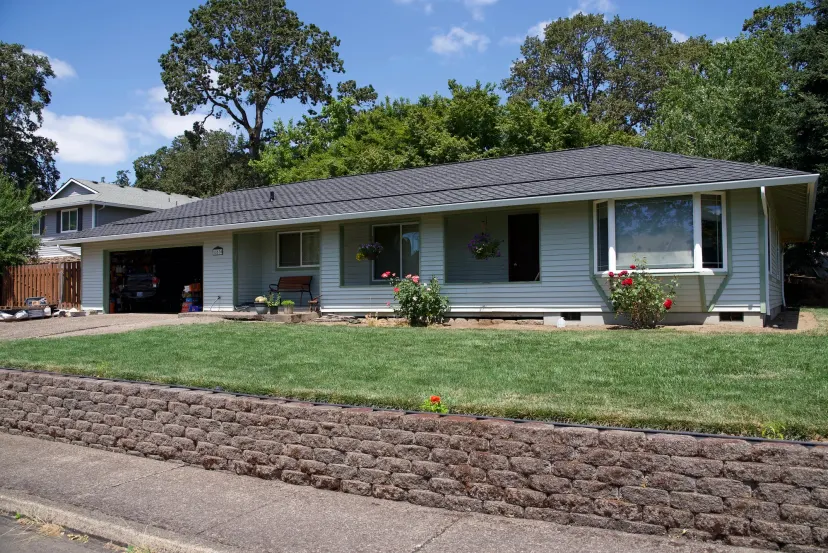
For most Portland homes, the best siding is James Hardie fiber cement: it does not rot, does not swell, holds paint far longer than wood, and carries a 30-year substrate warranty. Cedar still earns its place on historic homes and for owners who accept the upkeep, and vinyl can be the honest call on a tight budget. Pick siding for a house in Phoenix and the job is mostly about sun. Pick siding for a house in Portland and the job is about one thing: water. We get forty-plus inches of rain a year, months of damp shade on north-facing walls, moss on anything that sits still, and maybe nine truly dry weeks to repaint in. The right siding here is the one that shrugs off moisture without asking you to babysit it every spring. Here is how the four materials we get asked about most actually perform, and what we recommend after years of tearing failed siding off Portland-area homes.
What does Portland weather do to siding?
Before comparing products, it helps to know what they are up against. Our climate attacks siding three ways. First, bulk water: wind-driven rain that gets behind laps and trim if flashing and clearances are sloppy. Second, sustained damp: walls under tree canopy in places like Lake Oswego can stay wet for weeks at a stretch, which is paradise for rot fungi and moss. Third, short drying windows: paint and stain need dry days to cure, and we do not get many of them between October and June, so finishes that need frequent recoating become a real burden, not a line item.
How do the four siding options compare?
James Hardie fiber cement
Fiber cement is a mix of cement, sand, and cellulose fiber, and it behaves like it: it does not rot, does not swell, does not feed carpenter ants, and does not burn. Hardie is the brand we install as members of the James Hardie ALLIANCE, and it is engineered in a variant specifically rated for wet climates like ours. Paint adheres to it exceptionally well, so factory-finished boards can go well over a decade before they need attention. It is heavier and slower to install than wood or vinyl, which is why labor costs more — but it carries a 30-year substrate warranty, and in our experience it simply outlasts everything else on a wet wall.
LP SmartSide engineered wood
SmartSide is strand-board engineered wood treated with resins and zinc borate against moisture and decay. It is lighter than fiber cement, cuts and fastens like wood, comes in long lengths that mean fewer seams, and takes paint beautifully. Installed to spec, with every cut edge sealed and proper clearances off roofs and grade, it performs well in the Northwest. The honesty part: it is still a wood-based product. If an installer skips edge sealing or lets it sit against a wet surface, it will swell and delaminate, and we have replaced plenty of it. The product is good; the margin for installation error is thinner.
Natural cedar
Cedar is the traditional PNW answer, and nothing else looks quite like it. Old-growth cedar has natural rot resistance, and a well-maintained cedar wall can last generations. Two realities to price in. First, most cedar available today is second-growth, which is meaningfully less rot-resistant than the old-growth stock on a 1920s Irvington Craftsman. Second, cedar is a maintenance commitment: expect to clean and restain or repaint it on a three-to-seven-year cycle, and in our climate that work has to land inside a short dry season. Skip a cycle and the wall starts drinking water.
Vinyl
Vinyl is the budget option and it is not waterproof in the way people assume — it is a rain screen that sheds water down the wall while the weather barrier behind it does the real work. Premium vinyl holds up fine here, never needs paint, and cleans with a hose. The downsides are aesthetic and practical: it can look thin on older homes with real architectural character, it can crack in a hard freeze, and dark colors can warp on sun-exposed south walls. For a rental, a tight budget, or a straightforward subdivision home, it is a legitimate choice.
| Material | Installed cost (per sq ft) | PNW moisture behavior | Maintenance cycle | Best fit |
|---|---|---|---|---|
| James Hardie fiber cement | $15–$25 | Does not rot, swell, or feed pests; wet-climate rated | Repaint roughly every 12–15+ years | Most Portland homes, long-term owners |
| LP SmartSide | $14–$22 | Good if every cut edge is sealed; unforgiving of sloppy installs | Repaint roughly every 8–12 years | Budget-conscious jobs wanting a wood look |
| Natural cedar | $18–$28 | Naturally rot-resistant, but stays damp under canopy | Clean and restain every 3–7 years | Historic homes, owners who love the look |
| Premium vinyl | $11–$19 | Sheds water well; relies on the weather barrier behind it | Hose it off; no painting | Rentals, tight budgets, simple elevations |
Does cedar still make sense in Portland?
We are not going to tell a Sellwood Craftsman owner to wrap their house in panels. On historic homes, on accent gables, and for owners who genuinely love real wood and accept the upkeep, cedar is still the right call. The key is going in clear-eyed: you are signing up for a maintenance relationship with your house, and in this climate that relationship needs attention every few years. If that sounds like a chore rather than a pleasure, one of the engineered options will make you happier.
The part nobody puts in the brochure
Ask any siding crew what actually fails on Portland homes and you will get the same answer: not the siding — the wall behind it. Nine times out of ten, the rot we cut out traces back to a missing weather barrier, a window flashed wrong, or siding run tight against a roof line with no clearance. That is why the material comparison only gets you halfway. Whatever you choose, the assembly has to be built right: weather-resistive barrier taped and lapped, flashing at every opening, proper gaps off roofs and grade. A mid-grade product installed correctly will outlast a premium product installed carelessly, every single time.
What's the best siding for most Portland homes?
For the majority of homes we walk, we recommend Hardie fiber cement, and it is not close. It costs a little more than SmartSide up front, but it removes moisture from the list of things that can go wrong with your walls, holds its finish through winters that peel lesser products, and is backed by a 30-year substrate warranty. Pair it with a proper weather-resistive barrier and correct flashing — which is how we build every siding installation, from the sheathing out — and you have a wall assembly you will not think about again for decades.
If you are weighing colors and profiles, the fastest way to decide is to see them on your own house. Our SidingVision preview tool lets you try Hardie colors and styles on a photo of your actual home before you commit to anything. And when you are ready for real numbers, we will walk the house, tell you what shape the walls underneath are in, and leave you with an itemized proposal you can compare against any other bid.
Common questions
What is the most durable siding for Portland's climate?
James Hardie fiber cement. It does not rot, does not swell, holds paint far longer than wood, and carries a 30-year substrate warranty. In a climate with forty-plus inches of annual rain, that combination is hard to beat.
Is LP SmartSide good for the Pacific Northwest?
Yes, when it is installed to spec. SmartSide is an engineered wood product treated against moisture and fungal decay, and it performs well here. The catch is that it is still wood-based, so cut edges, clearances, and caulking have to be done exactly right or water finds a way in.
How much does new siding cost in Portland?
Installed pricing in our market runs about $15 to $25 per square foot for Hardie fiber cement, $14 to $22 for LP SmartSide, $18 to $28 for natural cedar, and $11 to $19 for premium vinyl, including removal of the old siding. Every home is different, so treat those as planning ranges, not quotes.
Can I put new siding over my old siding?
We do not recommend it in the PNW. Overlaying hides the condition of the sheathing and the weather barrier underneath, which is exactly where moisture damage hides on a Portland home. A proper job removes the old siding, inspects and repairs the wall, and rebuilds the assembly from the sheathing out.